
Armada Pro300 vs Pro700 vs Pro881 vs Pro900
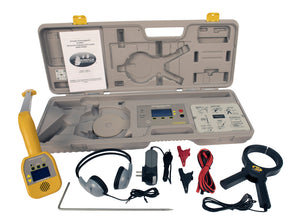

The right Armada locator depends on the cable access and locating methods your jobs require. The Pro300 suits shorter residential wire runs; the Pro700 focuses on wire and valve tracing; the Pro881 adds digital filtering and several signal-coupling options; and the Pro900 adds a broader set of controls and passive AC detection. Compare the models below, then shop Armada locators and diagnostic tools.
This is a buying guide, not a hands-on performance test. It compares manufacturer documentation and the models listed by Atlantic Lighting. Check the supplied kit and manual revision before ordering accessories or operating an existing unit.
Armada Pro300 vs Pro700 vs Pro881 vs Pro900 at a glance
| Model | Best starting point for | Useful distinction | Check before buying |
|---|---|---|---|
| Pro300 | Shorter residential sprinkler and landscape wiring | 2 kHz direct-connect system with null tracking | Whether a simpler, lower-power system meets the job |
| Pro700 | Routine contractor wire and sprinkler-valve tracing | Analog signal meters and a long receiving wand | Exact version and operating instructions |
| Pro881 | Mixed cable-tracing jobs needing digital filtering | 2 kHz and 33 kHz direct signals plus inductive operation | Clamp inclusion and the cable's required return path |
| Pro900 | Crews needing more locating modes and controls | Direct, clamp, broadcast and passive AC methods | Power accessories and model-generation compatibility |
When the Pro300 is enough
The Armada Pro300 is worth considering when most work involves accessible, shorter residential wiring. Its transmitter places a signal on the target conductor and the receiver follows that signal. The manufacturer's current description identifies a 2 kHz null-tracking system.
For example, a contractor who regularly traces a known sprinkler station wire may value a straightforward setup more than a larger selection of modes. Start with that job description rather than buying solely by the highest model number. Review the Pro300 operating guide (PDF) for the required connections and grounding.
Pro300 vs Pro700: residential focus or regular contractor tracing?
The Armada Pro700 provides analog signal indication, adjustable levels and a longer receiving wand for wire and valve work. It is a sensible comparison for a crew that uses a locator frequently and wants dedicated tracing equipment with visible signal feedback.
Version check: Armada's current Pro700 webpage and its linked September 2023 manual describe tracking differently. The manual describes null operation, while the webpage labels its current model peak-only. We therefore do not present one tracking mode as universal to every Pro700. Match your equipment to the Pro700 manual (PDF) and confirm any discrepancy with Armada before use.
Pro881 vs Pro900: which digital locator fits your work?
The Armada Pro881 offers digital filtering and direct or inductive locating with relatively simple controls. The Armada Pro900 is worth comparing when passive AC detection, a numeric display and more operating controls are useful to your crew. Both require the operator to select a suitable method and interpret the signal; digital filtering does not eliminate every source of interference.
Direct connection is useful when the target conductor can be safely accessed and isolated. A clamp can couple a signal without a metal-to-metal clip connection, but it still needs the return-path conditions specified in the manual. Broadcast operation can help when a direct connection is unavailable; it can also energize neighboring conductors. Buying an inductive-capable locator does not remove the need to identify which cable you are following.
Armada's current marketing also describes newer rechargeable power options. Older manuals specify different battery arrangements. Confirm the actual unit, approved adapters and included accessories rather than assuming every Pro900 or Pro881 package has identical power hardware.
Which one should a landscape-lighting contractor choose?
- Known, accessible residential cable: compare Pro300 and Pro700 against the run and working conditions.
- Several cable types or frequent interference: compare the Pro881 and Pro900 digital systems.
- No practical direct connection: evaluate inductive methods and their grounding requirements before choosing a kit.
- A suspected insulation leak rather than an unknown route: investigate a dedicated ground fault locator instead of assuming a higher-numbered path locator solves it.
These are selection scenarios, not guarantees of field performance. Branches, adjacent conductors, soil conditions and the signal return path can matter more than the model name. If lighting is not working, first use our landscape lighting troubleshooting guide to establish what is actually failing.
Questions to settle before ordering
- Are you finding the cable route, a valve, an open circuit or insulation damage?
- Can the cable be safely isolated for direct connection?
- Do you need a clamp or broadcast method, and will the cable support it?
- Which accessories and power supplies are included with the exact listing?
- Will the people using it have the training to recognize ambiguous signals?
Can a Pro900 replace a ground fault locator or TDR?
No. These instruments answer different questions. A route locator can help investigate severe cable damage, but it is not a universal detector of every nick or bad splice. Read wire locator vs ground fault locator vs TDR before selecting a fault-finding instrument. For operation, continue with how to use the Armada Pro900.
Manufacturer references
Reviewed November 9, 2026. See Pro300 instructions (PDF), Pro700 instructions (PDF), Pro881 instructions (PDF) and Pro900 instructions, Rev. 09/23 (PDF). The current Armada Pro900 product information should be checked alongside the manual supplied with your unit.
- Jenny Branch