
Wire Locator vs Ground Fault Locator vs TDR
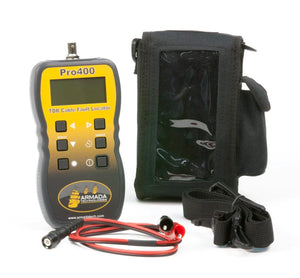

A wire locator follows a buried conductor's route. A ground fault locator helps pinpoint leakage from damaged wiring into earth. A TDR cable fault finder estimates the distance to an electrical discontinuity along compatible cable. Choosing between them starts with the question you need answered, not the word “locator” on the case.
This guide compares Armada's Pro900 wire and cable locator, GFL3000 ground fault locator and Pro400 graphical TDR. Browse the Armada brand hub for the complete listed assortment.
Compare what each diagnostic tool tells you
| Question | Tool category | Example | What the result does not prove |
|---|---|---|---|
| Where does the wire run? | Underground wire locator | Pro900 | That every splice and inch of insulation is sound |
| Where does damaged insulation leak to earth? | Ground fault locator | GFL3000 | The full route of the cable |
| How far along the cable is an open or short? | TDR cable fault finder | Pro400 | The exact spot on the ground without route information |
| What voltage or current is present? | Appropriately rated meter | Model selected for the circuit | The physical location of every underground defect |
Wire locators: follow the route and investigate changes
A path locator applies or detects a signal associated with a conductor. The operator follows that response above ground. Depending on the model and setup, this helps trace lighting cable, irrigation wiring or connected valve solenoids.
The Pro900 offers several ways to couple or detect a signal. It can also help investigate major breaks or damage, but a signal change needs interpretation. A service technician should separate “I lost the signal here” from “I confirmed a break here.” The former may also involve the tracing circuit, nearby conductors or the layout.
Example: an owner wants to extend a lighting system but has no cable map. Establishing the route is the first task. A TDR distance reading alone would not tell the installer which side of a planting bed the cable follows. Read our Armada wire locator comparison to choose a path-tracing model.
Ground fault locators: pinpoint a path from conductor to soil
The GFL3000 uses an earth-gradient method to help locate a grounded cable defect. Its receiver and A-frame respond to the test current's path through the ground. The important requirement is an electrical path from the damaged conductor to earth.
It is not a replacement for a cable route locator. A pure conductor-to-conductor short with intact insulation to earth is a different fault condition; do not assume a ground fault instrument will identify it. Ground contact and site conditions also affect how usable the response is.
Example: a direct-buried run may have insulation damage after landscaping work. If testing establishes leakage to soil, a ground fault locator may help narrow the repair area. A suspected nick alone is not enough to guarantee a usable ground-fault response.
Preparation matters: the GFL3000 produces high-voltage test pulses. Armada requires complete isolation of the cable from power and connected components. Read its operating instructions before use and switch off and disconnect the transmitter before handling the tested cable or making repairs.
TDR cable fault finders: estimate distance along the cable
A time domain reflectometer sends a pulse into a compatible cable and interprets reflections from changes in its electrical characteristics. The Pro400 displays events such as an open end or short and their approximate distance from the test point. The velocity-of-propagation setting, cable construction and cursor placement affect the distance result.
A TDR reading is cable distance, not straight-line ground distance. For example, an event indicated 120 feet along a run may lie closer than 120 feet from the test point on the ground if the cable turns or includes slack. That is why a route trace and a distance measurement can complement one another.
The Pro400 manual requires the cable to be disconnected from power and attached equipment. Match the cable type and instrument settings before interpreting the trace. Branched circuits and attached loads complicate interpretation; isolate a suitable section using the manufacturer's procedure rather than assuming the first displayed event is a failed splice.
Which tool finds a broken landscape lighting wire?
There is no single answer for every “broken wire.” First establish whether the problem is loss of supply, an open conductor, a short, a failed connection, damaged insulation or a fixture fault. Use our landscape lighting troubleshooting guide to organize those checks.
- Unknown route: trace the cable with an appropriate locator.
- Confirmed or suspected leakage to earth: evaluate a ground fault locator and the site's suitability.
- Open or short on a compatible isolated cable: consider a TDR for distance information.
- Uncertain supply or load behavior: use a meter with the correct functions and ratings, operated by someone qualified for the circuit.
A crew may need two tools because the tasks are different. Mapping a route, identifying an electrical defect and verifying a repair are separate steps. Avoid purchasing solely around advertised maximum range; the method must suit the fault and cable.
Frequently asked questions
Can a ground fault locator trace the entire cable?
The GFL3000 is intended to locate grounded faults, not map the complete cable path. Armada recommends a separate cable locator for that route information.
Can a TDR find every bad splice?
No. A detectable reflection and an interpretable trace are necessary. An intermittent issue may not be present during the test, and a change on the display is not automatically a defective splice.
Does a locator confirm a cable is de-energized?
No. A locating response—or its absence—is not an absence-of-voltage test. Follow the isolation and verification procedure for the circuit and instrument.
Where should I start if I already own a Pro900?
Use the Pro900 operating guide to review setup and signal interpretation. If the job is an insulation leak or a distance-to-fault question, use this comparison to decide whether another instrument is needed.
Manufacturer references
Reviewed November 9, 2026. Consult the Pro900 user guide (PDF), GFL3000 operating instructions (PDF) and Pro400 user guide (PDF). Confirm the manual and specifications for the exact equipment version. These examples explain tool selection; they are not reports of field tests performed by Atlantic Lighting.
- Jenny Branch