
Heat-Shrink Landscape Wire Connectors: ACE vs. Crimp
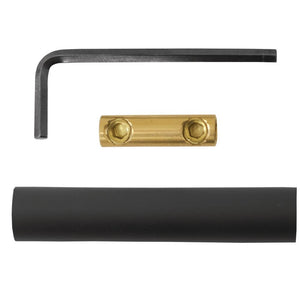

ACE connectors secure copper wires with a brass set-screw lug; KSC heat-shrink crimp connectors secure them with a crimped copper tube. Both use adhesive-lined heat shrink to protect the completed joint. Choose between them by wire construction, the approved wire combination, circuit voltage, and the tools available for the job.
For low-voltage landscape lighting, two distinctions matter immediately: ACE accepts solid or stranded copper and is limited to 15 volts AC or 30 volts DC. King’s current KSC instructions specify stranded wire only and a maximum voltage of 125 volts. A voltage rating alone does not establish suitability for every installation.

ACE family image: a set screw makes the electrical connection; the adhesive-lined sleeve seals the assembly.
ACE versus heat-shrink crimp connectors
| Feature | ACE | KSC (King Shrink Crimp) |
|---|---|---|
| Electrical joint | Brass lug tightened with an Allen wrench | Tin-plated copper tube compressed with the specified crimp tool |
| Wire construction | Solid or stranded copper | Stranded wire only in current instructions |
| Maximum voltage | 15 VAC / 30 VDC | 125 V; verify the intended installation separately |
| Sealing method | Adhesive-lined heat shrink | Adhesive-lined heat shrink |
| Tools | Wire stripper, Allen wrench, suitable heat source | Wire stripper, King Krimper with correct die, suitable heat source |
| Reuse | Do not reuse | Do not reuse |
Use the ACE manufacturer instructions and current KSC manufacturer instructions when matching a connector to the job. The installation details differ, even though the finished splices both have a heat-shrink covering.
Where ACE connectors fit
ACE is intended for low-voltage landscape lighting and direct-burial applications within its specified limits. Its set-screw design is useful when the approved copper-wire combination calls for a mechanical lug and you want a connection that does not require a crimp tool.
King 90330 medium ACE connectors come in a 50-pack. The medium size lists a #18–#8 copper wire range; small ACE lists #18–#12, and large ACE lists #18–#8. These ranges do not authorize every possible conductor bundle. Confirm the exact size, combination, and current requirement.
Check the transformer tap: a landscape system described as “12V” may have higher-voltage taps. ACE’s 15 VAC maximum still applies. Also check the conductor-specific current table; the maximum shown for the product does not apply equally to every wire gauge.
Where KSC heat-shrink crimp connectors fit
KSC connectors are intended for landscape lighting and compatible in-line electrical splices. The copper tube forms the joint after crimping; the adhesive-lined polyolefin tubing provides the protective covering. This makes tool selection and crimp quality central to the finished connection.
Use the King 46550 King Krimper with the die specified for the KSC model and conductors. Do not substitute a random crimp cavity based on how tightly it seems to squeeze. Current KSC instructions call for two crimps per side and include model-specific wire preparation.

KSC family image: the crimp tube and adhesive-lined sleeve perform different jobs.
| Model | Listed stranded-wire range | Pack |
|---|---|---|
| 72010 KSC-1 extra small | #22–#16 | 20 |
| 72020 KSC-2 small | #18–#12 | 20 |
| 72030 KSC-3 medium | #18–#8 | 20 |
| 72040 KSC-4 large | #18–#8 | 8 |
KSC-3 and KSC-4 share a listed gauge range but differ in physical dimensions and capacity. Do not treat them as interchangeable. Use the exact model’s permitted conductor arrangement, stripping instructions, and crimp-tool chart.
How to install ACE heat-shrink connectors
- Turn off power and confirm compatibility. Check conductor material, combination, voltage, and the connector’s current limits.
- Slide the heat shrink onto the cable first. Do this before stripping and joining the wires.
- Prepare the conductors for the ACE size. The linked instructions specify a 1/2-inch strip for small ACE and 5/8 inch for medium and large. Align frayed strands before insertion.
- Insert the wires and tighten the set screw. Use the Allen wrench and do not over-torque. Follow the manufacturer’s procedure for the chosen assembly.
- Position the tubing and heat evenly until sealed. Follow the manufacturer’s heat-source instructions and protect surrounding insulation from damage.
ACE does not need a crimp tool, but it still needs the correct wire preparation, secure set-screw connection, and complete heat-shrink seal. Do not reuse a previously installed connector.
How to use KSC heat-shrink crimp connectors
- Turn off power and select the correct KSC size. Use stranded wire as specified in the current instructions and verify the conductor combination.
- Prepare wires according to that model. Strip lengths differ. Certain smaller-wire combinations require longer stripping and folding back; do not apply one generic strip length to all four sizes.
- Slide the heat-shrink sleeve onto one side before joining. Align strands and fully insert the prepared conductors into the ports.
- Crimp with the specified King Krimper die. Follow the current tool chart and make two crimps per side as directed.
- Center the sleeve and heat evenly from the center outward. Finish according to the model instructions. KSC-2, KSC-3, and KSC-4 instructions call for fully compressed tubing and visible clear sealing adhesive.
The heat shrink protects the connection; it cannot correct a loose or incorrectly sized crimp underneath. Replace an improperly assembled connector instead of attempting to reuse it.
Common heat-shrink connector mistakes
- Forgetting the sleeve before making the joint. Put it on the cable before securing the lug or crimp tube.
- Choosing by wire gauge alone. The quantity and arrangement of conductors also affect fit.
- Using solid wire in KSC based on older literature. Follow the current KSC sheet’s stranded-wire requirement.
- Heating only one side or stopping too early. Follow the specified sequence and sealing criteria for the exact connector.
- Assuming ordinary tubing provides the same seal. Use the specified adhesive-lined sleeve as part of the complete system.
- Ignoring circuit voltage or burial requirements. Product appearance does not establish its rating.
Heat-shrink connector questions
Are all heat-shrink butt connectors suitable for landscape lighting?
No. “Heat-shrink butt connector” describes a broad product category used in many applications. Verify the particular connector’s conductor requirements, sealing system, voltage, and installation suitability. Automotive or general-purpose labeling alone does not establish direct-burial use.
Is ACE better than a crimp connector?
Neither method is universally better. ACE fits compatible low-voltage copper-wire applications when a set-screw lug is appropriate. KSC fits approved stranded-wire combinations when you can make the specified crimp. The correct connector and complete installation process matter more than the method alone.
How is KSC different from a silicone-filled copper crimp system?
KSC seals with heat shrink. Other systems place a copper crimp inside a silicone-filled housing. See our waterproof copper crimp connection guide for that separate approach.
Find the right connection system
Compare waterproof wire connectors, browse DryConn connectors including KSC, or read our DryConn types and sizes guide. If you are still choosing between twist-on, crimp, and heat-shrink systems, start with how to choose landscape lighting waterproof connectors.
Specifications reviewed in October 2026 against the linked ACE and KSC manufacturer instructions. Use the instructions supplied with your exact product and follow applicable electrical requirements.
- Jenny Branch