
Outdoor Wall Wash Lighting: Placement, Spacing & Uses
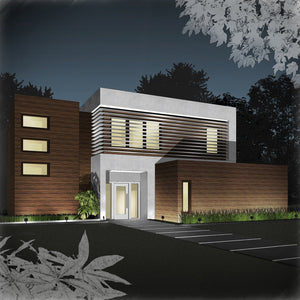

Outdoor wall wash lighting creates broad, relatively even illumination across a wall or landscape backdrop. Choose a fixture with a suitable distribution, then test its setback, spacing, and aim on the actual surface. Turning up a bright spot does not turn it into an even wash.
Use this guide to plan exterior wall wash lighting for a house facade, garden wall, or planting backdrop. If you are still deciding which fixture type fits the job, start with flood versus spot versus wall wash lights, then compare landscape flood and wash lights.

A wall wash creates a broad illuminated background. Illustration: Kichler Lighting.
Where should you use a wall wash?
A wash is useful when the surface should read as a whole rather than as isolated bright patches. It can establish a soft background behind planting, reveal the shape of a garden wall, or connect separate architectural features into one nighttime composition.
| Target | Effect to consider | What to check |
|---|---|---|
| Broad, relatively smooth facade | Even wall wash | Windows, light-colored finishes, eaves, and unwanted spill |
| Stone or deeply textured masonry | Compare washing with grazing | Whether you want to soften or emphasize texture |
| Garden wall behind a specimen plant | Wash the background for a silhouette | Keep the source concealed from the main viewing position |
| Broad shrubs or hedge | Broad flood or wash | Foliage can interrupt coverage and change as plants grow |
| Commercial sign | Controlled illumination of the sign face | Readability, uniformity, mounting, and glare |
A wash can contribute to the atmosphere around a path, but it is not a substitute for checking steps and walking surfaces. Treat decorative wall illumination and task visibility as separate parts of the lighting plan. Signs also deserve their own layout; see how to light an outdoor sign.
Wall washing versus wall grazing
Washing aims for an even appearance; grazing emphasizes surface relief. A light positioned close to textured masonry sends light across projecting edges and joints, making their shadows more visible. That can be attractive on stone, but it can also reveal repairs or uneven construction.

Grazing makes surface texture and shadows more prominent. Illustration: Kichler Lighting.
To soften texture, test a different setback and a distribution designed for a wash. Moving the light is only part of the solution: the optics, aiming angle, and wall height still determine where the light goes. Our landscape lighting techniques overview compares washing with grazing, shadowing, and silhouette effects.
How far from the wall should wash lights be?
There is no universal setback for every outdoor wall washer. A compact landscape fixture aimed upward from a planting bed is not the same as a ceiling-mounted architectural wall washer. Avoid transferring an indoor spacing rule to an outdoor fixture without checking its photometrics.
Measure the wall height and width, the available planting-bed depth, and the locations of windows and projections. Select an initial position from the exact fixture’s application information. Test whether the distribution reaches the desired upper edge without creating an excessively bright band at the base.
For a wall with limited setback, look for optics intended to distribute light over a vertical surface from that position. If the fixture cannot cover the wall at the available distance, more wattage will not fix the underlying geometry.
How to space wall wash lights for even coverage
- Define the area to illuminate. Decide whether the wash ends at a column, doorway, planting group, or the full wall width.
- Review the fixture’s distribution. Check horizontal and vertical coverage, not just total lumens. Use the photometric drawing at the intended mounting distance and orientation.
- Test adjacent fixtures together. A single fixture can look acceptable while a row produces visible bright centers and dark seams.
- Adjust overlap and aim. Move or re-aim fixtures to blend the light. Excessive overlap can create bright bands as easily as insufficient overlap creates gaps.
- Set brightness after the coverage works. Compare the wall with nearby landscape features so the background does not dominate the scene.
For example, on a wall divided by two windows, treat the solid sections as separate targets instead of placing fixtures at equal intervals regardless of the architecture. This is a layout approach, not a prescribed fixture count. The final number depends on measured coverage and the intended effect.
Choose 12V or 120V, then choose the light source
12V landscape flood and wash fixtures suit compatible low-voltage lighting systems. Confirm the fixture’s AC or DC requirement, transformer capacity, cable run, and voltage at the load. 120V outdoor flood and wash fixtures require the specified line-voltage installation and suitable mounting.
Voltage does not determine the beam shape or guarantee higher brightness. Choose the power system and the optical distribution as separate decisions.
For an integrated example, the Kichler 16026CBR27 VLO mini wall wash uses an integrated LED source in a 12V fixture. Review its hosted specification sheet. For a configurable modular example, the Lumien LAA-070 micro flood housing requires a compatible LED module selected separately. A modular engine is not the same as a standard replacement bulb.
Browse integrated and modular LED flood and wash fixtures or replaceable-lamp flood and wash fixtures. With either approach, check the complete package: light source, stake or mount, and controls. Read integrated LED versus replaceable lamps for the service differences.
Fix common wall-washing problems
- Bright circles with dark gaps: check distribution, spacing, and overlap before increasing output.
- Bright base and dark upper wall: reassess setback, aiming, and vertical distribution.
- Unwanted texture: compare a wash layout with the current grazing angle.
- Light in windows or above the wall: refine the target boundary and use approved shielding where available.
- A visible bright source from the patio: check the scene from seated eye level and reposition or shield the fixture.
- Shadows that appear later: inspect plant growth and seasonal foliage before replacing the light.
Wall wash lighting questions
Can a floodlight wash a wall?
Yes, if its distribution, position, and aiming produce the intended coverage. A wide beam label alone does not prove that it will illuminate a wall evenly from your available setback.
How many wall wash lights do I need?
Start with the surface dimensions and the selected fixture’s photometrics. Check the combined pattern of neighboring fixtures. Wall length alone cannot establish a reliable count.
Should wall wash lighting be 2700K or 3000K?
Test the available color temperatures on the actual finish and alongside existing lighting. Coordinate the appearance across the scene; changing color temperature will not correct uneven coverage.
Finish with an after-dark walkthrough from the street, paths, and seating areas. Record fixture positions and settings, then revisit after planting changes. Shop flood and wall wash lights once the intended coverage and power requirements are clear.
- Jenny Branch