
Flood vs. Spot vs. Wall Wash Lights: Which Should You Use?
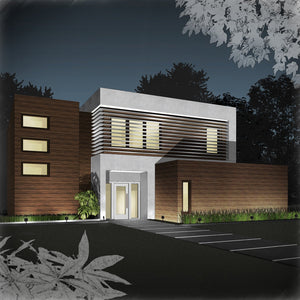

Choose a spotlight to concentrate light on a smaller feature, a floodlight for broader coverage, and a wall wash when the goal is relatively even illumination across a surface. The fixture name is only a starting point. Its optics, mounting position, distance, and aiming determine the result.
A landscape accent fixture can have a wide flood beam, and a dedicated wall washer can use an adjustable distribution. That does not make every wide-beam accent the same as a purpose-designed wash. Compare the intended task before comparing wattage.
| Type or effect | Typical use | Main selection question |
|---|---|---|
| Spot or concentrated accent | Slender trunk, column, sculpture, or distant detail | Does the beam stay on the intended feature? |
| Flood | Broad canopy, shrub group, planting bed, or wider feature | Does the spread cover the target at the actual distance? |
| Wall wash | Facade, garden wall, backdrop, or sign face | Is the surface evenly illuminated without excessive hot spots? |
When to use a spotlight
A concentrated beam helps separate one feature from its surroundings. It can suit a narrow column, branching detail, or object viewed from a particular position. A focused beam can also reach a distant feature without spreading as much light into adjacent areas.
Check the whole target, not just the center. A narrow beam that lights a tree trunk may leave the canopy dark. Increasing brightness does not broaden that beam. Use our uplighting placement guide and compare landscape accent and spot lights.
When to use a floodlight
A flood spreads light across a broader area. It can suit planting beds, broad shrubs, or a large landscape feature that does not need a tight accent. Coverage still depends on distance: the same optical spread makes a smaller footprint nearby and a larger one farther away.
For a dense canopy, branches may intercept light before it reaches the outer foliage. A wider beam is not always enough; more than one carefully chosen position may be needed. Our large-tree lighting guide addresses that specific design problem.
Browse landscape flood and wash lights for broad-coverage options. For security or general area lighting, confirm that the selected product’s mounting, controls, and distribution suit that application rather than assuming any landscape flood will do.
When to use a wall wash
A wash makes a wall or background read as a continuous surface. It can support a calm facade composition or create a lit backdrop behind planting. The key is the distribution across the surface, including how neighboring fixtures blend.

A wash emphasizes the surface as a whole rather than a single concentrated feature. Illustration: Kichler Lighting.
Washing is different from grazing. Grazing uses a shallow angle across textured material to emphasize shadows and relief. Read outdoor wall wash lighting: placement, spacing, and uses for the detailed layout process.
The Kichler 16026CBR27 mini wall wash is a 12V integrated wash example. The WAC 5222 adjustable wall wash offers a 120V example with adjustable distribution. These are different fixtures for different power systems; select the exact model that fits the site.
Why “spot” and “flood” labels can be confusing
Manufacturers use beam names differently. A lamp called “wide flood” may still sit inside an accent fixture. A product listed as a wall wash may have unequal horizontal and vertical spreads rather than a circular pattern.
Read the degree values, distribution diagram, and photometric information. Do not transfer a circular beam estimate to a rectangular wall-wash pattern or assume that all light stops at the nominal beam boundary.
For replaceable MR16 lamps, our MR16 beam-angle and coverage chart gives a worked geometric explanation. That guide addresses lamp selection; this comparison addresses the fixture’s job in the landscape.
Compare useful light, not wattage alone
Wattage tells you electrical consumption. Lumens describe total output. Neither tells you on its own how evenly a wall will look or how much light will reach a distant detail.
For similar optical systems, concentrating light into a narrower beam generally increases its intensity near the center. Spreading it across a larger area changes that concentration. Use photometric data and an on-site test to judge the result on the target.
12V versus 120V is a separate choice
12V flood and wash lights need a compatible low-voltage power system. Verify AC/DC requirements, connected load, wiring, and voltage drop. 120V outdoor flood lights require an appropriate line-voltage supply and installation.
Neither voltage category guarantees a particular beam shape, brightness, or quality. For an externally illuminated business sign, start with our 120V sign-lighting guide to compare coverage and mounting.
Integrated, modular, or replaceable lamp?
Integrated LED fixtures have a purpose-designed light engine. Some have manufacturer service parts; others have a different replacement procedure. Check the exact product.
Modular LED fixtures use compatible manufacturer modules. For example, the Lumien LAA-070 micro flood requires a separately selected module. Other configurations can include one, so verify what comes in the box.
Replaceable-lamp fixtures accept a specified bulb. Match its base, physical dimensions, voltage, and maximum permitted wattage. “NL” identifies no-lamp versions where used in the product listing.
Compare integrated and modular LED fixtures with replaceable-lamp flood and wash fixtures, then use our light-source serviceability guide for the longer-term ownership questions.
A quick selection checklist
- Name the target and the intended viewing position.
- Decide whether the effect should be concentrated, broad, or even across a surface.
- Measure the available mounting distance and review the distribution.
- Choose the compatible supply and light-source approach.
- Test coverage and glare after dark before finalizing output.
Common questions
Can a spotlight have a flood beam?
Yes. Accent-style fixtures can use wide-beam lamps or adjustable optics. The beam label describes the distribution, not necessarily the fixture’s role or housing category.
Are wall washers only for walls?
No. A suitable broad distribution can illuminate planting backdrops or a sign, but the mount, rating, and actual coverage must suit the application.
Should I use the widest beam available?
Choose the spread that fits the target. An unnecessarily wide beam may send light into windows or neighboring property while reducing useful concentration on the feature.
Explore flood and wall wash fixtures or compare accent and spot lights with the intended effect in mind.
- Jenny Branch