
Kichler Integra Spotlights & 15DM20SS PLC Dimmer Guide
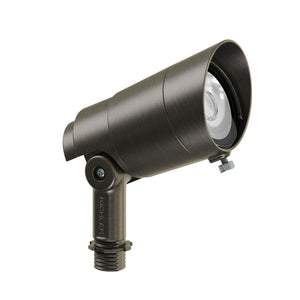

Kichler Integra integrated LED spotlights give landscape designers three output levels—200, 375, and 600 lumens—with a choice of finishes, beam spreads, and PLC dimming. That flexibility makes it easier to give a large tree the attention it deserves while keeping a small ornamental planting or architectural detail in balance.
The advantage is a coordinated family of accent lights that can serve different jobs across the same property. Choose the output for the subject, the beam for its shape, and the brightness for its place in the overall scene.
Current lineup: three finishes, three lumen outputs, two fixed beam spreads—35° and 60°—and 2700K or 3000K color temperature. Kichler’s current ordering guide does not list a third beam spread. View the Integra specification and ordering guide.

Kichler Integra at a glance
| Selection | Options | Design decision |
|---|---|---|
| Light output | 200, 375, or 600 lumens | Match the light level to the subject and surrounding scene |
| Beam spread | 35° or 60° | Choose a more concentrated or broader distribution |
| Finish | Textured Architectural Bronze, Textured Black, Centennial Brass | Coordinate visible hardware with the property |
| Color temperature | 2700K or 3000K | Choose a warmer appearance or a slightly crisper warm white |
| Dimming | 100% down to 10% with Kichler’s compatible PLC dimmer | Fine-tune the balance after choosing output and optics |
200 vs. 375 vs. 600 lumens: give every feature the right role
A successful landscape lighting design usually needs a hierarchy. One tree may be the main focal point, a secondary planting may add depth, and a small detail may provide a quiet accent. Giving all three the same brightness can make the scene feel flat or overlit.
| Output | Useful starting applications | How it supports the design |
|---|---|---|
| 200 lumens | Small ornamentals, close-range details, modest planting accents | Creates restrained highlights without making every element compete |
| 375 lumens | Medium-size shrubs or trees, entry features, supporting architectural accents | Bridges subtle foreground accents and the strongest focal points |
| 600 lumens | Larger trees, taller architectural features, subjects that need more light | Provides the highest output in the Integra family for demanding focal points |
These are design starting points, not guaranteed coverage sizes. Distance, foliage density, surface color, reflectivity, beam angle, and background illumination affect the result. A pale wall can look bright with relatively little light, while a dark trunk or dense canopy may need more output or multiple viewing angles.
Why the 600-lumen Integra matters for large trees and architecture
The 600-lumen models give designers more output to work with when a focal point rises above the rest of the landscape. Consider a tall entry feature, a substantial trunk, or a large specimen tree that disappears after sunset. More available light can help carry the composition upward and give these subjects a stronger presence.
For a defined vertical feature, start by evaluating the 600-lumen 35° Integra. For a broader section of foliage or architecture, compare the 600-lumen 60° version. The wider beam spreads the available light over more area; it does not automatically reach as strongly at distance.
A large tree may still need more than one fixture to reveal its shape. Lighting from different positions can show trunk texture, major branches, and canopy depth more effectively than concentrating all the light in one spot. Aim into the intended subject and control spill beyond it.
Why the two lower-output options are equally useful
The 200- and 375-lumen options give designers more control over the supporting parts of the landscape. A small tree beside a seating area does not always need the same emphasis as the large tree at the end of the garden. A stone detail near the entry may need a soft highlight rather than a bright patch.
Use the 200-lumen 35° Integra for a defined, modest accent, or compare the 375-lumen 35° Integra when the subject needs more presence. For broader coverage at those levels, the 16301 and 16303 families provide the 60° options.
Here, “smaller” describes the output rather than a separate miniature fixture size. The coordinated appearance lets designers vary illumination while keeping the visible hardware consistent.
35° vs. 60° beam spread: output and coverage are different
Lumens describe total light output. Beam spread helps describe how that light is distributed. Two 600-lumen fixtures can create very different results because one concentrates the light more tightly.
Kichler’s photometric table illustrates the difference at a 16-foot distance: the 600-lumen 35° model lists 8.6 foot-candles and a 9.1-foot beam width, compared with 2.4 foot-candles and an 18.1-foot beam width for the 600-lumen 60° model. A foot-candle measures illumination at the target. These are published test figures, not a promise that every tree or angled wall will receive those values. See the manufacturer’s photometric table.
Use the narrower option when concentration matters; use the wider option when the subject benefits from broader coverage. Dimming can reduce brightness, but it does not turn a 60° optic into a 35° optic. Select the beam before trying to solve the whole design with the dimmer.
Choose among three Integra finishes
| Finish | Code | Where it can fit visually |
|---|---|---|
| Textured Architectural Bronze | AZT | Earth tones, masonry, mulch beds, and traditional exteriors |
| Textured Black | BKT | Dark trim, contemporary exteriors, and black landscape hardware |
| Centennial Brass | CBR | Projects where a warm brass fixture complements the surrounding materials |
Compare the same 600-lumen 35° configuration in Architectural Bronze, Textured Black, and Centennial Brass. Finish is a visual choice, while the housing material also deserves consideration: Kichler lists cast aluminum for AZT/BKT and brass for CBR.
How the Kichler PLC dimmer works with Integra
The Kichler 15DM20SS PLC Landscape Dimmer provides manual brightness control for compatible Integra fixtures. PLC means Power Line Communication: control information travels over the landscape wiring to fixtures designed to understand it.
The dimmer is placed on the low-voltage side of the system, between the landscape transformer and the compatible load. It is a control device, not a replacement for the transformer. Kichler specifies a dimming range from full output down to 10%. Kichler’s PLC dimmer overview.

One dimmer can control up to 20 compatible fixtures
The limit is 20 PLC-compatible fixtures per dimmer, total. Kichler’s instructions allow multiple outgoing runs from the same output as long as the combined count stays at or below 20. Splitting the wiring into two branches does not give each branch a separate 20-fixture allowance. Read the 15DM20SS installation instructions.
Also check electrical loading, wire size, voltage drop, and the transformer’s capacity. A fixture-count limit does not replace those calculations. Use each selected model’s VA specification when sizing the supply, and plan for full rated output rather than relying on a dimmed setting to make an undersized system work. Our landscape transformer sizing guide explains the load-planning process.
Control a lighting zone with a shared dimming setting
Think of one PLC dimmer as a shared brightness control for its compatible load. Group fixtures by how you want them to behave: an architectural accent zone may need a different balance from a garden seating area. Do not assume that one manual dimmer provides individually addressable control of 20 fixtures.
Use multiple inline PLC dimmers to control different areas
A project can use multiple inline PLC dimmers, with each controlling a separate compatible lighting group. For example, put the front trees on one dimmer, architectural accents on a second, and garden features near the patio on a third. This lets the installer or homeowner adjust one area without forcing the same brightness change across the entire property.
Plan each dimmer on its own low-voltage branch from the appropriately sized transformer system, following Kichler’s wiring diagram. Do not place dimmers in series or join their controlled outputs. The 20-compatible-fixture limit applies to each dimmer; the transformer must still support the combined load of every branch.
Separate dimmers provide separate manual brightness controls. Independent scheduling requires the appropriate upstream control arrangement; adding a PLC dimmer alone does not create an app-controlled or independently timed zone. See Kichler’s typical application diagram.
A platform with room for more compatible fixtures
Kichler currently identifies both Integra and Varia accent lights as PLC-compatible. Atlantic Lighting reports that Kichler plans to release additional PLC integrated fixtures. That planned expansion could give designers more fixture types to coordinate within future projects, but select today’s equipment from the published compatibility list and confirm each new model before adding it.
Leave practical room for expansion in the wiring layout and transformer capacity if the project calls for it. Future product plans do not change the present dimmer limits, and no unreleased model or launch date should be assumed. Current Kichler PLC compatibility overview.
The transformer and its timer handle the broader power schedule; the PLC dimmer sets brightness for compatible fixtures. Keep those functions distinct when planning the homeowner’s controls.
Installer workflow: pre-set brightness before arriving on site
Atlantic Lighting’s installer guidance is that Integra fixtures can be dimmed before installation, disconnected from the PLC dimmer, and retain the selected brightness when installed on a suitable supply. This offers a useful preparation workflow: establish intended brightness levels in the shop, label fixtures by location, and arrive with a more organized installation plan.
For example, a designer could prepare a softer accent for a small ornamental tree, a stronger setting for an entry feature, and a higher setting for the main specimen tree. The benefit is consistency and preparation, especially when multiple installers need to follow the same design.
Verify the retention behavior on the exact fixtures being supplied before using this workflow across a project. Record each fixture’s model, planned location, and intended setting; disconnect power before changing connections. After removing the PLC dimmer from the setup, check that the fixture starts at the intended brightness on the final type of supply.
A shop setting is a starting point. Finish with a nighttime review on site, because real foliage, mounting distance, and wall reflectivity can change the effect. If the finished installation includes an active PLC dimmer, treat its compatible fixtures as a shared control group and check the result again; do not assume earlier individual settings remain independent of later commands.
Verification note: the pre-setting workflow above is supplied by Atlantic Lighting. The public Kichler documents reviewed confirm PLC dimming and the 20-fixture limit, but do not explicitly document retention after removing the PLC dimmer.
An example: one landscape, three levels of emphasis
Imagine a front garden with a large tree, a stone entry column, and a smaller ornamental tree near the walkway. The large tree is the focal point; the column gives the home definition; the smaller tree adds a welcoming foreground accent.
- Large tree: evaluate 600 lumens and choose the beam around the trunk and canopy shape. Add viewpoints if a single fixture leaves the tree looking flat.
- Entry column: start with 375 lumens and a beam that stays on the intended surface. Reduce brightness if reflective stone becomes the dominant feature.
- Small ornamental: start with 200 lumens so it supports the composition without competing with the main tree.
Then adjust aiming and brightness while viewing the property from the road, entry walk, and interior windows. The goal is a clear focal point with supporting layers, rather than maximum brightness everywhere.
Kichler Integra model-number lookup
Start with the five-digit model family, then select the finish and color-temperature suffix. The beam is fixed by the model; the PLC dimmer changes brightness.
| Model family | Output | Beam |
|---|---|---|
| 16300 | 200 lumens | 35° |
| 16301 | 200 lumens | 60° |
| 16302 | 375 lumens | 35° |
| 16303 | 375 lumens | 60° |
| 16304 | 600 lumens | 35° |
| 16305 | 600 lumens | 60° |
For example, 16304CBR27 identifies the 600-lumen, 35° version in Centennial Brass at 2700K. AZT is Textured Architectural Bronze, BKT is Textured Black, and the 30 suffix identifies 3000K. Confirm the complete selected SKU in the ordering guide and current listing; a family number alone does not specify the finish or color temperature.
Ordering and installation checklist
- Choose the subject and viewing direction before selecting output.
- Choose 35° or 60° optics for the target’s shape and distance.
- Specify finish and color temperature consistently.
- Decide whether the PLC dimmer will remain installed for ongoing control.
- Count compatible fixtures per dimmer and calculate the electrical load separately.
- Plan suitable cable, connections, aiming access, and glare control.
Follow the current fixture and dimmer instructions. The PLC knob’s light-off function does not isolate the output wiring; Kichler instructs installers to turn power off at the transformer before adding or removing fixtures. Keep incompatible fixtures on separately planned runs according to the current instructions. See the PLC installation and compatibility requirements.
Kichler Integra and PLC dimmer FAQs
Does Integra have three beam spreads?
The current manufacturer ordering guide lists two: 35° and 60°. There are three output levels and three finishes.
Is 600 lumens enough for a tall tree?
It is the highest-output Integra option and a useful starting point for demanding subjects, but tree size alone cannot determine the answer. Consider distance, beam spread, foliage, desired emphasis, and whether multiple fixtures are needed.
Can all Integra lights use the same dimmer?
Integra is listed as compatible with Kichler’s 15DM20SS PLC dimmer. Stay within the 20-compatible-fixture total and all electrical and installation limits.
Can I change the beam spread with the dimmer?
No. Dimming changes brightness. Select the 35° or 60° fixture for the distribution you need.
Can I use a standard household dimmer instead?
Do not substitute an ordinary wall dimmer for the specified PLC control. Follow Kichler’s compatibility instructions for the complete low-voltage system.
Choose Integra around the design
Use the 600-lumen option where the landscape needs a stronger focal point, and the 200- and 375-lumen options to build supporting layers. Match the beam to the subject, then use the PLC dimmer where ongoing brightness control is useful. Compare landscape accent lights and bring Atlantic Lighting your fixture locations and lighting goals to select the right combinations.
- Jenny Branch