
Dock Lighting Ideas: Recessed and Underwater Lights
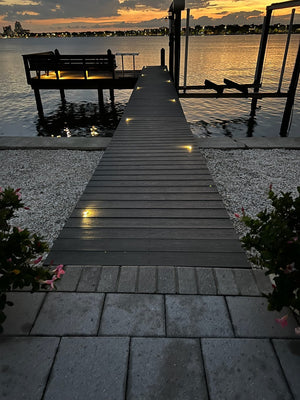

A good dock lighting plan combines low-glare lights on the walking surface with separate lighting for seating, boarding, and the water below. Recessed fixtures keep a narrow dock uncluttered. Underwater lights add a different layer: a pool of color beneath the dock that makes the waterfront enjoyable after sunset.
For a clean, permanent installation, consider Lumien Micro modules with compatible recessed accessories on the dock and Incredible Underwater Lights below it. Choose each system for its location, power requirements, and purpose.

Dock lighting ideas: choose a light for each job
| Dock area | Lighting approach | What to prioritize |
|---|---|---|
| Walkway and deck edges | Recessed Micro lights with a directional cap | Visible walking route, low glare, little hardware above the surface |
| Steps and changes in level | Shielded step or downlighting | Seeing the tread and transition clearly |
| Bench or seating area | Concealed or low-mounted accent lights | Comfortable light without shining into seated eyes |
| Boat boarding area | Dedicated, shielded task lighting | Visibility at the actual boarding point as water levels change |
| Water beside the dock | Submersible underwater dock lights | Water compatibility, color, output, cord route, and service access |
Begin with the route people use. Mark the entrance, turns, steps, seating area, and boarding point before deciding where underwater lights belong. A bright glow in the water does not show every trip hazard on the deck.
Recessed dock lighting with Lumien Micro modules and LAB-099
The appeal of a recessed light is simple: most of the fixture sits down inside the dock instead of standing above it. This is especially useful on narrow walkways where people carry coolers, fishing gear, or dock lines.
The Lumien LAB-099 Brass Micro Circular 180° Opening accessory pairs with a compatible Micro module. Its directional opening lets the installer orient the light toward the walking surface. LAB-099 is the accessory, not a complete powered light. Select the matching module as part of the assembly. Lumien identifies this accessory in its current catalog as BQCM-MKR-099-A. See Lumien’s accessory specifications.

Can you drill a hole and drop the light into the dock?
That is the basic recessed-mount concept: make the correctly sized opening and seat the compatible assembly in the dock. The body drops below the walking surface; the cap finishes at the surface. Depending on the accessory, the trim can remain slightly proud, so “recessed” is more precise than promising a completely flush top.
Recommended drill bit: For the 1-3/4-inch opening used for the Lumien Micro recessed installation in wood decking, use the Milwaukee 48-25-1752 1-3/4-inch Selfeed Drill Bit. Match the hole size to your selected Micro module and recessed accessory before drilling.
Before drilling, confirm the current assembly’s cutout diameter, mounting depth, retention method, and clearance beneath the board. Check the underside for framing and wiring, and avoid structural members. Follow the decking manufacturer’s requirements for holes and the fixture manufacturer’s assembly instructions. Test-fit one location before drilling the entire dock.
For warm walkway lighting, compare the 2700K brass Micro module with the 3000K brass Micro module. The former creates a warmer appearance; the latter is a slightly crisper warm white. Choose the output and compatible cap together, then check the effect at night.
Lumien lists its Brass Micro module family for 10–15V operation. Use the specified compatible supply and properly assembled seals and connections. A module’s ingress rating does not establish that every assembled accessory is suitable for every saltwater or continuously submerged location; confirm the intended exposure with Lumien. Review the Micro module specifications.
Incredible Underwater Lights for saltwater and freshwater docks
Incredible’s Apollo and Mega-Watt underwater lighting systems are offered for both saltwater and freshwater. They provide a separate underwater layer for lake docks, canals, and coastal waterfronts. Their current product pages describe the supplied light, driver, cord, and anchoring components. Apollo system details; Mega-Watt system details.
120V plug-in power with a 24V DC driver
The system plugs into a 110–120V AC outlet; the included electronic driver converts that supply to 24V DC for the underwater light. It is often described as a transformer, but the AC-to-DC driver distinction matters when matching equipment. Use the supplied system components. The underwater light and the 10–15V Lumien Micro modules need their own compatible power supplies. Manufacturer power and cord specifications.
Choose the output family and cord length
| Choice | What it means for your dock |
|---|---|
| Apollo | Manufacturer’s current family page advertises up to 16,000 lumens. Confirm the selected color and model’s rating. |
| Mega-Watt | Higher-output family. Confirm the exact SKU’s lumen rating before ordering; published manufacturer ratings differ. |
| Single color or IRIS | Choose a single-color appearance or an IRIS model that displays two colors simultaneously. |
| 40-, 80-, or 120-foot cord | Choose the factory cord length that accommodates the complete installation route. |
Specification note: the current Mega-Watt product page advertises up to 32,000 lumens, while the manufacturer’s FAQ still lists 22,000. These figures should not be treated as interchangeable specifications for every SKU.
Measure from the intended driver location along the actual cord route and down to the underwater light. Allow for the dock’s movement, changing water levels, and the installation requirements. A 40-foot dock does not automatically mean a 40-foot cord will reach. Order the appropriate factory length instead of planning an improvised underwater splice.
Compare the green Apollo with a 40-foot cord, 80-foot Apollo, and 120-foot Apollo. For the higher-output family, see the green Mega-Watt.
How to lay out dock lights without overlighting
- Mark hazards first. Identify steps, turns, edges, cleats, and boarding locations. Keep fixtures and cords clear of normal foot traffic and dock operations.
- Place a few walkway lights temporarily. Evaluate their actual spread on your decking before repeating a spacing pattern. Dark decking and directional caps change the result.
- Check both standing and seated views. Aim directional openings across the surface instead of toward eyes, neighbors, or approaching boats.
- Add underwater lighting separately. Choose an accessible location clear of propellers, lifts, and moving hardware. Follow the light’s depth and anchoring instructions.
- Test after dark. Look for dark transitions and uncomfortable glare, then adjust placement or output. More fixtures are not automatically a better layout.
There is no single correct spacing for every dock. Beam pattern, fixture output, mounting position, deck color, and surrounding darkness all matter. A nighttime mockup is more useful than blindly applying a universal feet-between-lights rule.
Plan the electrical installation and maintenance
Have a qualified electrician familiar with docks verify the supply, required ground-fault protection, equipment placement, and applicable waterfront requirements. Keep the driver and line-voltage connections in the manufacturer-approved location, protected from water and flooding. “Plug-in” describes the connection; it does not remove dock electrical requirements. ESFI explains the importance of sound electrical systems around boats and marinas in its waterfront electrical safety guidance.
Disconnect power before installing, moving, or servicing an underwater light. Incredible specifies that its light must not be operated out of the water. Arrange the installation so the light can be retrieved and cleaned according to its instructions, and inspect cords and attachments after storms. Read the manufacturer’s installation instructions.
For the separate low-voltage deck circuit, plan cable size, load, and run length together. Our landscape lighting wire guide and transformer sizing guide explain those fundamentals; the dock equipment’s instructions still govern the installation.
Dock lighting FAQs
Are recessed lights a good choice for a dock?
They can be an excellent choice where a low-profile fixture helps keep the walking area clear. Check the assembled fixture’s exposure suitability, mounting clearance, and trim height before selecting it.
Can underwater lights replace walkway lights?
No. Treat them as separate lighting layers. Underwater illumination can leave the dock surface, steps, and boarding transition poorly defined.
What color should underwater dock lights be?
Choose the appearance you enjoy and consider your fishing goals. Green and blue are common options, but fish response depends on the species and conditions. Read what color dock lights attract fish for the comparison.
What should I measure before ordering?
Record dock length and width, walking routes, steps, water depth and level changes, the full cord route, and access to a suitable power source. For recessed lights, also measure the available depth below the decking.
Build a dock lighting plan around your waterfront
Start with the walking route, add comfortable seating and boarding illumination, and then choose the underwater effect. Browse dock lighting to compare options. Bring your measurements, dock photos, and desired light color to Atlantic Lighting so the fixture, accessory, cord length, and power requirements can be checked together.
- Atlantic Lighting