
RGB vs. RGBW Landscape Lighting: What Changes?
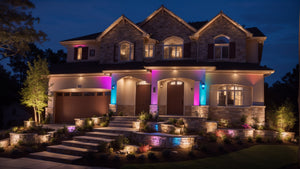

RGB combines red, green, and blue light. RGBW adds a separate white-light channel. That additional channel can make a product more useful for everyday white lighting, but the exact color temperature, output, and color rendering depend on the model.
What the letters do not guarantee
RGBW does not guarantee a particular CRI, a 2700K white, or compatibility with another brand's controller. Products described as RGBWW or tunable white may use additional white channels, but naming conventions vary. Read the actual specifications.
Design two kinds of scenes
Start with the normal nighttime scene for paths, entrances, and seating. Add decorative color to selected trees or walls. Keep the route people walk easy to see, and avoid excessive brightness or distracting effects near streets and neighboring windows.
Choose the control system with the lamps
Check the required transformer or driver, controller, app, and network arrangement. A color-changing lamp that physically fits a fixture may still need a different electrical or control setup. Verify how groups, schedules, and power-restoration behavior work.
Test the white scene before buying in quantity
Compare the sample on the actual surface, including how skin tones and planting appear in nearby occupied areas. Evaluate white and saturated-color scenes separately; their output can differ. Save the normal scene so the installation can return easily to everyday use.
RGB vs. RGBW: compare the channels, then the product
| Label | What to establish before buying |
|---|---|
| RGB | Red, green and blue channels create colors; a mixed white appearance does not establish the quality of a dedicated white source |
| RGBW | Adds a white channel; verify its color temperature, output and color rendering |
| RGBWW or RGB+CCT | Terminology varies; confirm the actual white channels and any adjustable Kelvin range |
| Tunable white | Adjustable white appearance within the listed range; this alone does not promise saturated colors |
For a landscape used every night, judge the everyday white scene first. A convincing holiday color effect does not establish whether the same lamp lights a path comfortably or matches the warm-white lights beside the front door.

A real RGBW example: Brilliance Chameleon MR16
The Brilliance Chameleon MR16 offers RGB color and white adjustment from 2200K to 5700K using the Brilliance Smart app. The manufacturer requires a consistent 2.4 GHz Wi-Fi signal at the installed lamp. This is a requirement of this product, not a rule for every RGBW system.
Before using it as a replacement, check the MR16 fit, supply requirements and enclosure. Brilliance specifies damp-location use in totally enclosed luminaires and excludes underwater use. See the manufacturer's Chameleon MR16 page for current setup guidance.
Questions to settle before installing color-changing lamps
- Normal scene: what white appearance and brightness should return after a holiday?
- Coverage: does the control signal reach the actual installed location?
- Power: when does the transformer remove power, and how does that interact with app schedules?
- Grouping: can paths remain in white while selected trees use color?
- Recovery: what happens after a power interruption or loss of network access?
Is RGBW always better than RGB?
A dedicated white channel is useful when white lighting is part of the job, but compare the actual white output and quality. For purely decorative color, other factors such as beam coverage and control compatibility may decide the choice.
Can RGBW lamps from different brands share one app?
Only when the manufacturers explicitly support that combination. Matching voltage or lamp shape does not establish app or controller compatibility. Choose the control platform before buying lamps in quantity.
Related guides
Shop for your project
- Tags: LED RGBW RGBW LED RGBW Lighting
- Greg Kelly